






Markets
March 31, 2026
UAE Fuel Prices Surge as Two Global Oil Chokepoints Come Under Pressure
Amazon stock dropped more than 10% in extended trading following Thursday’s Q4 earnings call, and the reason investors reacted so strongly right now is pretty clear. The company unveiled its plans to spend a staggering $200 billion on capital expenditures in 2026, which significantly exceeded what Wall Street had been expecting.
The Amazon stock price plunged as the massive spending forecast caught analysts off guard. After all, most had estimated around $146.6 billion for the year. Fourth-quarter revenue came in strong at $213.39 billion for Amazon, with advertising alone bringing in $21.32 billion.
The problem was on the earnings side, where AMZN posted $1.95 per share when analysts were looking for $1.97. That small earnings miss, paired with the massive capex guidance, explains why Amazon stock drops accelerated so dramatically in after-hours trading.
Also Read: Meta Stock Price Could Tank 15%, Investors Warned

The Amazon earnings call revealed what you might call a complex picture for investors, and also highlighted just how aggressive the company’s spending plans have become. Despite AWS revenue growing 24% to $35.58 billion, AMZN stock dropping reflected deep skepticism about the company’s aggressive AI infrastructure spending plans. The Amazon stock price took a particularly hard hit as concerns mounted over when these massive investments would actually start generating returns.
CEO Andy Jassy defended the record Amazon capex during the earnings call, and his statement left no room for doubt:
“With such strong demand for our existing offerings and seminal opportunities like AI, chips, robotics, and low earth orbit satellites, we expect to invest about $200 billion in capital expenditures across Amazon in 2026, and anticipate strong long-term return on invested capital.”
However, the AMZN stock price concerns intensified when the company also guided first-quarter operating income between $16.5 billion and $21.5 billion, which came in below analyst estimates of $22.04 billion. The market’s reaction came swiftly and pretty brutally. Market observers noted the harsh comparison: while Google and Microsoft received passes for similar massive capex plans thanks to higher cloud growth rates, Amazon got punished despite AWS posting its fastest growth in 13 quarters at 24%.
Mark Mahaney, an analyst at Evercore, pressed executives on what’s really the core investor concern right now:
“That’s the debate in the market today. Help us get to your level of confidence.”
Jassy responded by emphasizing that AWS was monetizing capacity as fast as the company could install it. He called the current moment an extraordinarily unusual opportunity to forever change the size of AWS and Amazon as a whole, and he pushed back against the idea that this was reckless spending.
Also Read: Earnings Beat Can’t Stop GOOG Stock Price From Dropping
Jassy had this to say: “This isn’t some sort of quixotic top-line grab.”
Sky Canaves, who’s a principal analyst at EMARKETER, offered a more measured take on the Amazon earnings results:
“Amazon delivered a slightly mixed picture with strong overall revenue growth and a standout boost from the cloud unit’s much anticipated reacceleration picking up greater speed.”
Sliding sharply into after-hours trading, Amazon stock continued falling below $230 as investors weighed whether the strong revenue growth justified the massive spending plans. The scale of such AMZN stock drops caught many by surprise, especially given the strong AWS performance. Historical data shows that Amazon stock drops following earnings calls typically recover within weeks, but analysts say this time might be different.
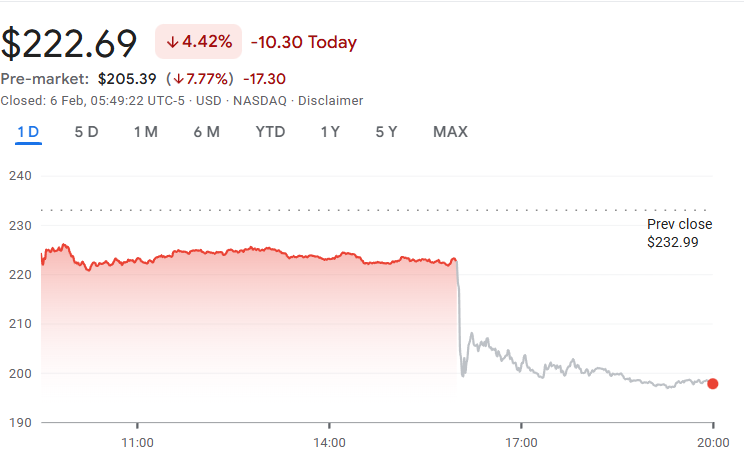
It’s worth noting that the Amazon capex announcement follows similar moves by other tech giants. Google plans to spend between $175 billion and $185 billion, while Meta’s capital expenditures could reach $115 billion to $135 billion. Combined, Big Tech’s AI spending now races past half a trillion dollars for 2026, which has been making investors increasingly nervous about returns and raising questions about when Amazon earnings will reflect these massive infrastructure investments.
Also Read: What to Invest in 2026: The 14% Portfolio Gap No One Talks About
The AMZN earnings miss on profit, combined with the eye-popping Amazon capex forecast, has essentially forced investors to rethink their assumptions about the company’s near-term profitability. Wall Street had expected stronger operating income guidance, and the shortfall there has added fuel to concerns about whether the fall will continue if the spending doesn’t translate into faster revenue growth soon. When AMZN stock drops sharply like this, it usually takes several quarters for investor confidence to rebuild.
Some analysts are also now questioning whether the Amazon stock drop signals a broader shift in how the market values AI infrastructure investments. At the time of writing, the market sentiment remains cautious, with many analysts still trying to figure out whether Amazon’s massive bet on AI infrastructure will pay off as quickly as management seems to believe it will.