





Business
March 26, 2026
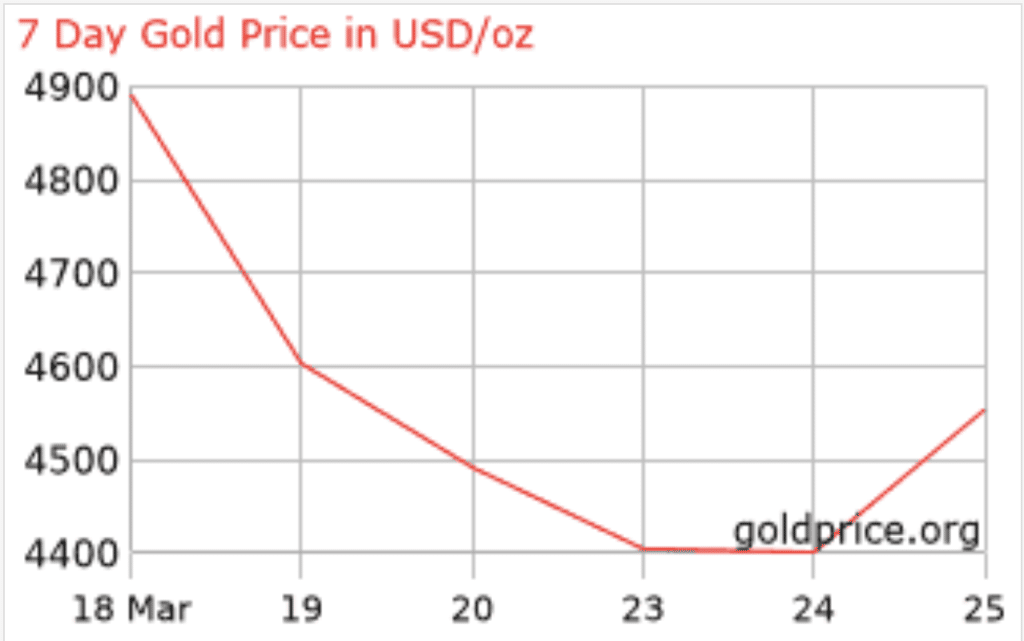
Gold is not behaving like it usually does. In what should have been a textbook safe haven moment for gold, the metal has slipped into a sharp bear market. Gold was seen logging in 10 straight days of losses. Prices have tumbled as much as 27% from their January peak of $5,594 per ounce. For a market that usually thrives on fear, gold’s sudden losing streak seems to have caught several investors off guard.
Also Read: $580M Oil Bet 15 Min Before Trump’s Iran Post Points to Insider Trading
When the Iran conflict escalated, gold did what it always does at first, it rallied. Prices briefly surged past $5,400 as investors rushed in. But this did not hold. Prices have reversed sharply since then. Spot gold is now trading closer to the $4,400 range. The broader move has pushed gold firmly into a bear market, according to reports. The latest gold price crash has also marked its worst weekly performance since 2011. Rajat Bhattacharya, senior investment strategist at Standard Chartered, said,
“Although gold initially gained due to safe haven demand at the start of the [Iran] conflict, prices have recently pulled back. We see this pattern often repeated during periods of heightened market stress as investors raise cash to pay margin calls or simply book profits where they can.”
The latest shift has less to do with geopolitics and more with macro conditions. A stronger US dollar has reduced demand by making gold more expensive for international buyers. The dollar index has gained nearly 3% since the start of the conflict. At the same time, Treasury yields have remained elevated. The 10-year yield is around 4.3%. This limits the appeal of non-yielding assets like gold.
Also Read: Iran War Triggers Chip Shortage and Your Next Device Pays for It
There is also evidence of forced selling. During periods of market stress, investors often sell liquid assets, including gold, to raise cash or meet margin requirements. This pattern was seen during both the 2008 financial crisis and the 2020 pandemic sell-off. Gold declined before recovering.
Part of the decline also reflects positioning. Gold has rallied more than 60% over the past year. This was mostly driven by geopolitical risks and central bank demand. As volatility picked up, some investors reduced exposure. Zavier Wong, market analyst at eToro, said,
“Gold’s recent rally to record highs was driven less by inflation than by a broader loss of confidence: fiscal deficits, geopolitical fragmentation, and central banks quietly diversifying away from dollar reserves. After a run like that, some position unwinding was inevitable. Gold has been one of the better-performing assets over the past year, and when markets get choppy, leveraged funds and institutional investors tend to reduce exposure.”
Despite the current trend, analysts still view gold’s longer-term role as intact. Historically, it has shown a negative correlation to equities during deeper market drawdowns. It often recovers once liquidity pressures ease.
Also Read: Franklin Templeton Expands Tokenized ETFs With Ondo Into 24/7 Markets