








Markets
March 29, 2026
Ever since Iran closed the Strait of Hormuz after the strikes by the US and Israel, economies across Asia are reeling under intense pressure, both from rising oil prices and falling currencies, according to Reuters.
Currencies like the rupee (India), the rupiah (Indonesia), and the peso (Philippines) have already fallen to record lows in recent weeks and show no signs of recovery.
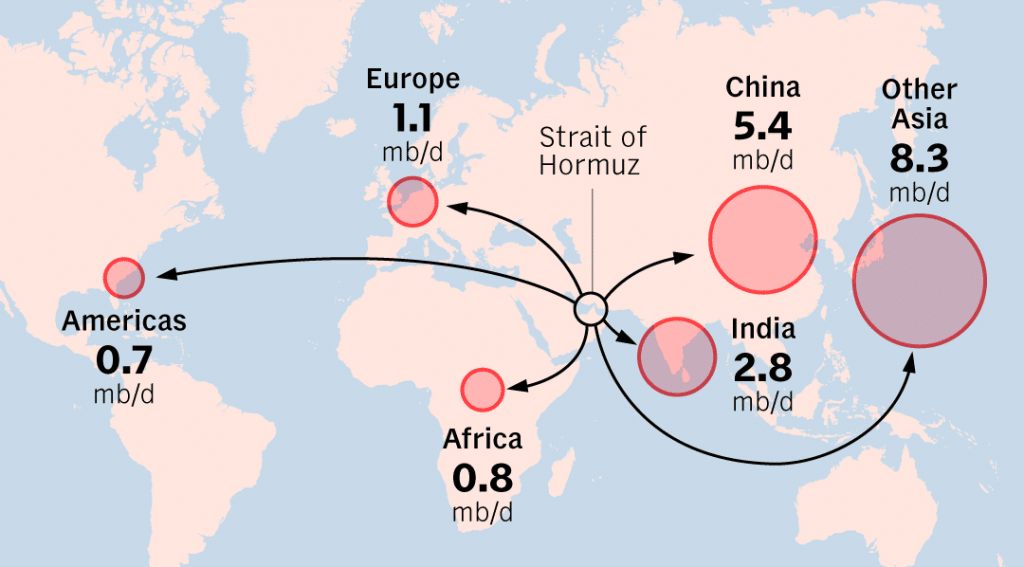
The Iran war impact on Asia is bigger than other parts of the globe, as the region is the biggest exporter of oil and LNG from the Middle East, with a large part coming through the Strait of Hormuz. China imports 5.4 million barrels per day, India 2.8 mb/d, and other countries in Asia total 8.3 mb/d, taking the total to around 16.5 mb/d.
Also Read: BNP Paribas ETNs Open Door to Bitcoin and Ethereum for Investors
Brent crude prices have spiked sharply since the war began, and are expected to rise further if the US commits boots on the ground, which could escalate the conflict. This is leading to a surge in oil prices across Asia. Countries like India, Japan, and South Korea, which depend on imports for most of their energy needs, are particularly exposed to this shock.
Fuel prices are rising, with some countries even exploring additional measures to absorb the shock.
According to a report in the South China Morning Post, Indonesia plans to reduce its free meal program for children to five days a week from six, a move expected to save $2.3 billion. India, on its part, has reduced excise duty on fuel to keep the prices from rising.
Highlighting the impact of the conflict, Lawrence Anderson from RISA said,
“Oil and gas powers the high-energy-consuming Asian economies and manufacturing practices, all of which makes them highly vulnerable to the disruption in the energy supplies from Iran and the Gulf states.”
The US-Israel-Iran war is also having a different impact on Asian FX, with Asian currencies falling and showing high volatility in March. The Japanese Yen fell by 1.42%, the Singapore Dollar by 1.18%, the Indian Rupee by 3.31%, and the Korean Won by 4.31%.
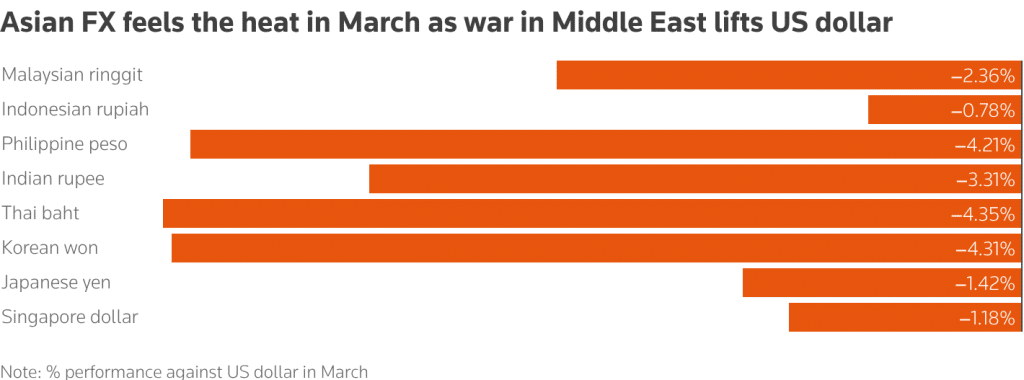
Speaking about the impact, Sonal Varma, Chief Economist at Nomura, said there are no easy options.
“I think the crux of the matter is that there are no easy policy options at this stage. Whether it’s the role of currency, monetary policy (or) fiscal policy. There will be some macro variables that will take an impact. Each country will essentially need to choose what is the right trade-off that is palatable in their local circumstances.”
Also Read: Bitcoin Miners AI Pivot: Q1 Report Hits as Mining Costs Reach $80K
The broader concern across Asian countries is that rising fuel prices and weakening currencies could lead to slower growth and higher inflation. If that conflict continues, countries may face fuel shortages, which would be one of the disastrous impacts of the Iran war on Asia.