








Bitcoin
March 23, 2026

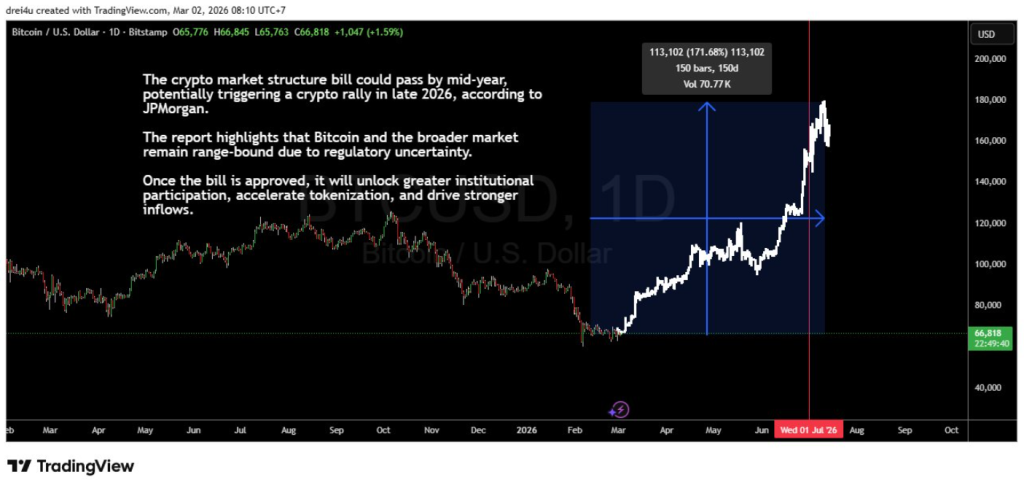
The Clarity Act crypto bill could be the single biggest catalyst for digital asset markets in 2026, but not everyone agrees on when the rally will start. JPMorgan analysts led by managing director Nikolaos Panigirtzoglou say a mid-year approval of the legislation could unlock sidelined institutional capital and drive a broad 2026 crypto rally in the second half of the year. But some traders argue markets won’t wait that long, pointing to a classic “buy the rumor, sell the news” pattern that could push prices up as much as 150 days before the bill becomes law.
Right now, crypto market structure remains uncertain, Bitcoin is range-bound near $68,000, and institutional adoption crypto has stalled—not due to lack of interest, but due to the absence of a clear legal framework.
Also Read: Market Outlook This Week After Iran Strikes & Oil Surge
Not everyone agrees JPMorgan’s H2 2026 timeline is accurate. One analyst argued markets could start pricing in the Clarity Act crypto passage as much as 150 days before it’s signed, following a classic buy-the-rumor pattern seen in past legislative catalysts. This would place the rally start somewhere in Q1 2026 (potentially right now) rather than waiting until after mid-year approval.
The logic is simple: institutional investors don’t wait for certainty. They position ahead of high-probability regulatory shifts, especially when those shifts unlock billions in sidelined capital. If the bill is expected to pass by July, smart money starts flowing in March or April, not August. The analyst also noted that rallies driven by anticipated legislation typically see a pullback around the actual signing date, followed by renewed momentum.
JPMorgan analysts framed the Clarity Act crypto legislation not as a minor regulatory update but as a structural transformation of the U.S. digital asset market. The bill would split jurisdiction between the SEC and CFTC, ending years of regulation by enforcement. The bill would also allow new projects to raise up to $75 million annually without full SEC registration, and enable tokens to transition from securities to commodity status once sufficiently decentralized, opening the door to broader institutional adoption crypto at scale.
The analysts stated:
“While sentiment remains negative in crypto markets, we continue to believe that a potential approval of the market structure legislation most likely by mid year could serve as a positive catalyst for crypto markets into the second half of the year.”
Also Read: XRP Rich List: Whale Power & Distribution
Two major sticking points remain: stablecoin yield treatment and conflict-of-interest restrictions pushed by Democrats. Coinbase also withdrew support for the bill, citing concerns over certain provisions, which has slowed momentum in the Senate. If these issues aren’t resolved, the mid-year timeline could slip—or the bill could fail entirely.
Crypto firms want to offer rewards to users holding stablecoins, while banks argue that allowing yield on stablecoin balances could pull deposits away from the traditional banking system and pose financial stability risks. Democrats are also pushing for restrictions that would prevent senior government officials and their families from engaging in certain crypto-related financial activities.
Still, JPMorgan maintains its long-term Bitcoin target of $266,000 and sees the crypto market structure bill as the most important U.S. catalyst in years. Whether the rally starts now or in H2 2026 depends on how quickly markets price in legislative probability—and whether traders believe JPMorgan’s conservative timeline or the more aggressive buy-the-rumor thesis.