









Bitcoin
March 31, 2026
Google’s Quantum Findings Put Bitcoin Security on a 10-Minute Clock
Nvidia GPUs have long been the backbone of Bitcoin mining operations worldwide. Now the Nvidia backed startup Starcloud is taking that further, preparing to deploy ASIC miners aboard Starcloud‑2 in what would be the first space crypto mining mission ever attempted. The company already ran Nvidia H100 GPUs in orbit via Starcloud‑1, and is now applying that same orbital data centers architecture to Bitcoin specifically.
Also Read: The Gulf’s Most Vulnerable Commodity: A $3.16T Region’s Water Under Attack

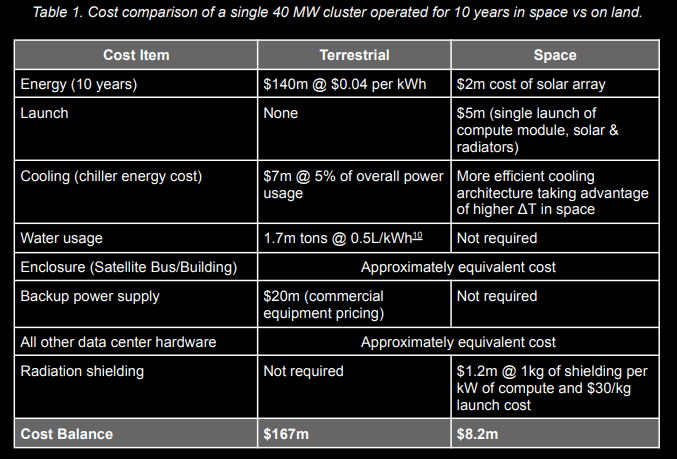
Bitcoin mining already consumes around 20 GW of power continuously, and total data center demand is forecast to hit 200 GW by 2030. Terrestrial energy infrastructure cannot keep up. Running a 40 MW compute cluster on Earth for 10 years costs an estimated $167 million. The same cluster in orbit costs around $8.2 million, according to Starcloud’s whitepaper, with savings coming from free solar power, passive cooling, and no backup power or water cooling required.
Philip Johnston, co-author of the Starcloud whitepaper, stated:
“The cat is out of the bag: Starcloud‑2 will be the first to mine Bitcoin in space. This will be a massive industry in itself. Right now, bitcoin mining consumes about 20 GW of power continuously. It makes no sense to do this on Earth, and in the end state, all of this will be done in space.”
Also Read: BRICS: India Says It Never Needed US ‘Permission’ to Buy Russian Oil
Space-based solar arrays generate over five times the energy of an equivalent terrestrial setup, running at above 95% capacity factor with no day/night cycle or weather losses. Cooling is handled passively, with radiator panels dissipating waste heat directly into deep space at no energy cost. Each compute module packs server racks, liquid cooling, and network switches into a single dockable unit.
Tom Mueller, employee #1 at SpaceX, stated:
“The amount of power to run compute by 2045 will be the base power of the planet right now. The drain on resources is so high, you need to put that compute in space and use the power of the sun…that’s a really good use of space to help save the planet.”
Also Read: The Ultimate War Portfolio: Stocks Built for Global Conflict
One heavy-lift launch deploys up to 40 MW of compute, and Starcloud’s whitepaper confirms 5 GW of total capacity is reachable with fewer than 100 launches. For space crypto mining, that means no permitting delays, no grid dependency, and no water usage. Starcloud, the first Nvidia backed startup to test this in practice, plans to scale its operations through orbital data centers.
Starcloud flew Nvidia H100 GPUs aboard Starcloud‑1 and validated their performance in orbit, proving high-performance hardware can operate reliably in space and laying the groundwork for Bitcoin-specific ASIC deployment on Starcloud‑2.
A 40 MW space cluster costs $8.2 million over 10 years versus $167 million on Earth, per Starcloud’s whitepaper, driven by free solar energy, passive cooling, and eliminated infrastructure costs.
Space arrays run at 95%+ capacity factor on pure solar with no grid dependency, removing the carbon footprint and energy strain that make terrestrial Bitcoin mining environmentally controversial.