



Markets
September 14, 2026
Fed, ECB and BOJ May Hike Together as $2.35T Carry Trade Faces Test
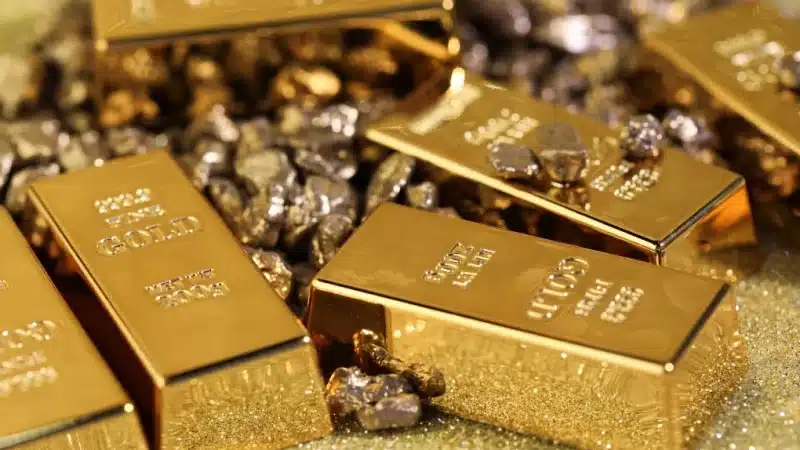
Gold has spent much of 2026 forcing investors to reconsider what counts as an expensive entry point. The gold price reached $4,442 on Tuesday before slipping back, yet China bought more gold in August than in any month for nearly three years. Falling Treasury holdings have made the US dollar part of that story. The numbers seem to describe a clean reserve swap. But one side of the trade remains surprisingly difficult to prove.
Also Read: Liquid Network Lost $320M Without a Compromised Key: What Does That Mean?

Spot gold was trading at $4,400.50 on September 8, down 0.3% after touching $4,442.70 earlier in the session. The decline followed a 2.4% drop on Friday, when stronger US employment data pushed traders to price in a roughly 60% chance of another Federal Reserve rate increase.
Nikos Tzabouras, senior market analyst at Tradu.com, said,
“Gold trades cautiously today, caught between Fed rate hike bets and dollar softness.”
Gold does not produce income, so higher interest rates raise the opportunity cost of holding it. A weaker dollar, geopolitical risks, and central-bank demand are pulling in the opposite direction.
China’s latest reserve figures offer the bulls their strongest argument. According to official data, the People’s Bank of China added 650,000 fine troy ounces in August, or approximately 20.2 metric tonnes. It was the largest monthly increase since October 2023 and extended the central bank’s buying streak to 22 months.
Also Read: Fomo Crypto App Explained: Can Social Trading Change How We Trade Onchain?
The pace of accumulation has picked up. The PBOC added about 15 tonnes in June, 20 tonnes in July and another 20.2 tonnes in August. Purchases during the first eight months of 2026 totalled approximately 80.3 tonnes, taking reported holdings to around 2,387 tonnes.

At Tuesday’s spot price, that stockpile would be worth roughly $337 billion. The August purchase alone was worth close to $2.9 billion.
China is buying at historically high prices, suggesting the programme is not built around finding a cheap entry point. Gold’s role as an asset without another government’s credit risk appears to matter more.
China is not alone. In its 2026 Central Bank Gold Reserves Survey, the World Gold Council found that 45% of respondents expected their institutions to increase gold holdings over the following year. Another 74% expected the dollar’s share of global reserves to decline over five years.
This sounds like a powerful case for de-dollarization. It still does not establish that China sold Treasuries specifically to pay for its gold.
China’s reported Treasury holdings dropped 4% in June to $633.4 billion, their lowest level since September 2008. The position was down 13% from a year earlier and had fallen to less than half its 2013 peak.
A 13% annual reduction implies a decline of roughly $95 billion. China’s 80.3 tonnes of 2026 gold purchases are worth around $11.3 billion at the current price. Even before considering timing and valuation changes, the two amounts are nowhere close to matching.
There is another problem. Treasury country data is collected mainly through custodians. The US Treasury acknowledges that these reports “cannot attribute holdings of US securities with complete accuracy.” Chinese assets held through financial centres such as Belgium, Luxembourg or the UK may be assigned to those locations.

A Federal Reserve analysis published this month went further. It found that foreign official Treasury holdings still exceeded gold by around $1 trillion when the five largest legacy gold holders were excluded. Much of gold’s apparent rise in reserve portfolios came from price appreciation, not purchases.
Beijing’s financial system is not moving in one direction. Chinese commercial banks have recently increased Treasury purchases after offering higher rates on dollar deposits. Foreign-currency deposits in China reached $1.18 trillion in July, rising 17.9% from a year earlier.
“Essentially, domestic yields are too low,” one banking source told the publication. Treasuries still offer Chinese lenders a liquid place to put those dollars.
China’s broader foreign-exchange reserves also increased from $3.419 trillion in July to $3.438 trillion in August. At current market prices, its official gold represents about 10% of that reserve pool. The country is diversifying, but it remains deeply connected to dollar markets.

The more consequential change may be happening in the plumbing of the gold trade. Hong Kong imported almost 100 tonnes of Russian gold during the first seven months of 2026, nearly three times the volume recorded during the same period last year. Since 2022, Hong Kong entities have purchased about $35 billion of Russian bullion.
LSEG analyst Debajit Saha said,
“Russian producers have increasingly redirected exports to eastern markets.”
Those imports are larger than the PBOC’s reported purchases this year, but they should not be treated as central-bank acquisitions. Gold entering Hong Kong can move to refiners, commercial banks, jewellers and private investors.
Hong Kong is also expanding storage, centralised clearing and links with the Shanghai Gold Exchange. Renminbi-denominated products could allow more of the metal to be traded and settled within Asia. This does not displace London or the dollar overnight. It gives China greater control over the routes through which physical metal reaches its market.
US nonmonetary gold exports reached $47.25 billion in the first quarter of 2026, compared with $15.46 billion a year earlier. Full-year exports had already climbed from $38.2 billion in 2024 to $111.5 billion in 2025.
Price effects are substantial too. The US non-monetary gold export price index was 82.6% above its December 2024 baseline in March 2026. Export values can therefore surge without physical quantities rising at the same pace.
China is accumulating gold, reducing its visible Treasury position and helping build an Asian gold network. These are meaningful structural developments that could strengthen long-term demand.
The claim that China is dumping the US dollar to buy gold goes beyond what the public records show. Custodial gaps obscure its true Treasury exposure, Chinese banks are still buying US debt, and the estimated value of PBOC purchases is far smaller than the decline in reported Treasury holdings.
For investors, monthly tonnes matter more than dramatic dollar comparisons. Continued PBOC buying near $4,400 would provide the gold price with credible support. A stronger dollar, higher rates or a pause in China’s purchases would test how much of the rally rests on that confidence.
Also Read: Nvidia Hugging Face deal Alters Global Artificial Intelligence Software Development Pipelines

Written by Sahana Kiran
Sahana Kiran has been covering financial markets since 2019, with a focus on cryptocurrencies, fintech, and the geopolitical events shaping them. She previously reported for AmbCrypto and Watcher Guru, and now writes for BlockNow.


