


Business
September 13, 2026
Revolut KYC Data Breach Leaks Names, Passport Photos, and Crypto Histories to Online Attackers
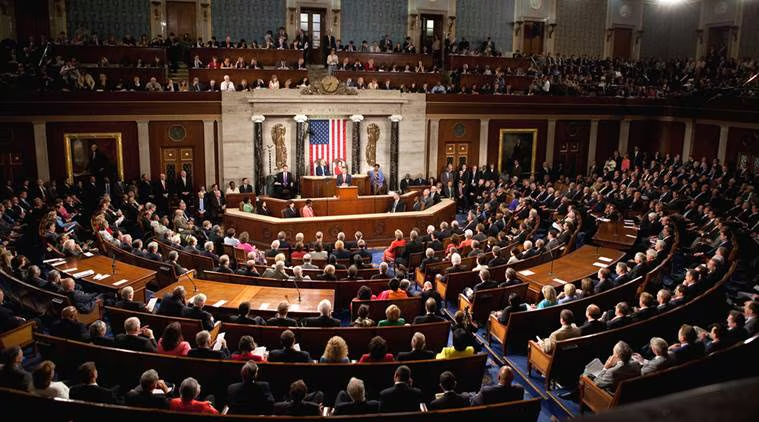
Members of Congress are once again under scrutiny for their activity in the stock market, particularly as they continue to shape policy around AI and crypto. Recent data show that several lawmakers have significantly outperformed the broader market while trading in sectors they directly oversee. The trend is drawing renewed attention as efforts to limit congressional trading continue to stall.
Also Read: Strait of Hormuz Has a Ceasefire, a $2M Toll, and 800 Ships Still Stuck

According to data from ProCap Insights covering January 2024 to April 2026, several members of Congress outperformed the S&P 500 by wide margins. Ro Khanna led with returns higher than the index by 112.1%, followed by Nancy Pelosi at 38.5%, Marjorie Taylor Greene at 21.6%, and Michael McCaul at 20.8%. The outperformance spans both political parties.
Khanna reported over 4,100 traders with a total volume of $53.4 million during this period. He also serves on committees related to artificial intelligence, antitrust, and technology. Many of these most commonly traded stocks among lawmakers include Nvidia, Microsoft, Amazon, Alphabet, and Apple, all of which are closely tied to AI development.
Trading activity remains high overall. In 2025, members of Congress executed more than 14,000 traders, totaling approximately $720 million. Around 100 out of 311 disclosed portfolios outperformed the S&P 500 that year.

The trend extends beyond equities. At least 10 members of Congress reportedly hold between $750,000 and $2 million in crypto assets while working on crypto regulation. This overlap has raised concerns about potential conflicts of interest. This is particularly as lawmakers continue to debate how digital assets should be governed.
Some investors have begun tracking these trades directly. The NANC ETF, which mirrors stock purchases disclosed by Democratic lawmakers, has gained 70% since its launch in February 2023. The fund is largely driven by positions in major tech firms.

Also Read: New Report Ties Bitcoin Creator Identity to Blockstream CEO Adam Back
Efforts to restrict congressional trading have so far made limited progress. The Stop Insider Trading Act was introduced in January 2026 and has moved through committee, but it still has not reached a full House vote. A vote was expected in the first quarter, but that deadline passed without any action. Texas Republican Rep. Chip Roy said,
“That’s frustrating that we’re not moving it, and the leadership knows that, and we’re pressing it.”
The current rules fall under the STOCK Act, passed in 2012. Lawmakers are required to disclose trades within 45 days. The penalty for late disclosure is $200. There have been no prosecutions under the law to date.
Despite ongoing criticism, stock trading by members of Congress continues. This is even as they play a direct role in regulating the industries they invest in.
Also Read: Shiba Inu & XRP Land on Rakuten Wallet as SHIB Pockets 4% Gains

Written by Sahana Kiran
Sahana Kiran has been covering financial markets since 2019, with a focus on cryptocurrencies, fintech, and the geopolitical events shaping them. She previously reported for AmbCrypto and Watcher Guru, and now writes for BlockNow.


