



Markets
September 14, 2026
Fed, ECB and BOJ May Hike Together as $2.35T Carry Trade Faces Test
The Iran war is starting to show up in places far from the Gulf. While the disruptions began around the Strait of Hormuz, another route, Bab al-Mandab, is now making news. Together, the two handle a significant share of global energy flows. For Europe, the impact is already visible in fuel markets. Amidst this, officials are beginning to flag near-term risks rather than longer-term scenarios.
Also Read: Good News Friday: Israel–Lebanon Ceasefire, Wall Street Surges

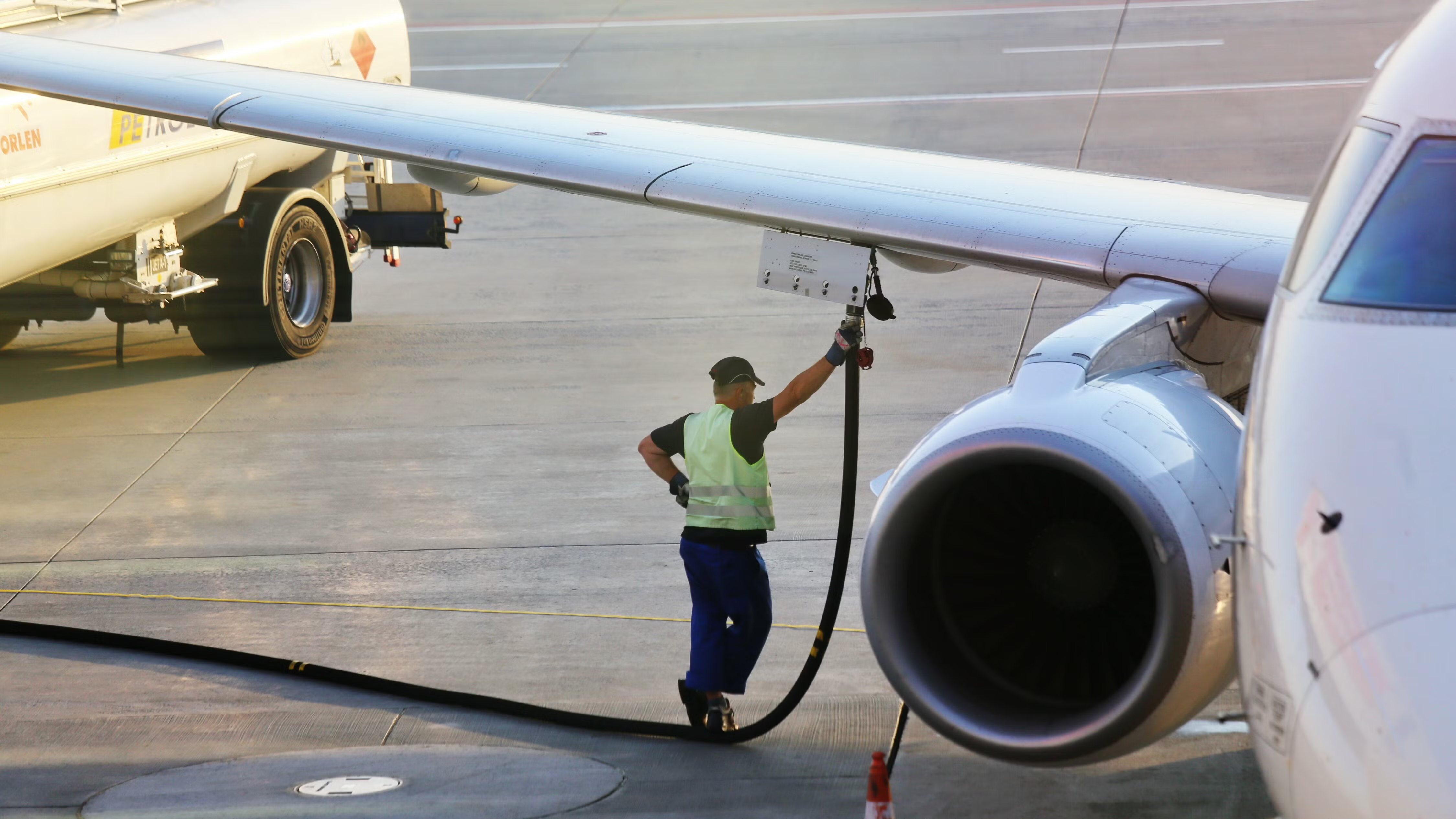
The International Energy Agency’s Fatih Birol said this week that Europe may have about six weeks of jet fuel left if current disruptions continue. He warned that flight cancellations could follow if the supply does not improve. He added,
“I can tell you soon we will hear the news that some of the flights [in Europe] from city A to city B might be cancelled as a result of lack of jet fuel.”
The issue is structural. Europe imports roughly 75% of its jet fuel from the Middle East. With flows through Hormuz still limited, replacement supply from other regions has not been enough to fully compensate.
Jet fuel prices in Europe have climbed sharply. It briefly touched around $1,800 per ton. This is more than double pre-war levels. The rise tracks closely with tighter crude and refined product supply since the Iran war began.
Oil markets are also under pressure. Goldman Sachs estimates that flows through Hormuz remain at about 10% of normal levels. Even after pipeline rerouting and reserve releases, the net hit to global oil stocks is around 10.4 million barrels per day.

Lufthansa CTO Grazia Vittadini elaborated on the same and said,
“our [jet fuel] suppliers are changing their forecasting windows, and they’re no longer keen to give an outlook over a time window that goes beyond one month.”
Also Read: Charles Schwab Just Put Bitcoin in Front of 39 Million Americans
Attention is now shifting to Bab al-Mandab. Iranian officials have revealed possible action starting April 17. This raises concerns that another key route could be affected. The Strait is already sensitive due to Houthi activity in the region.
If disruptions extend to both Hormuz and Bab al-Mandab, the impact on global energy trade would widen significantly. Analysts estimate that the two routes together account for roughly a quarter of global oil and gas flows.
Some effects are already visible. Italian airports have started limiting refueling in certain cases. A regional airline in Guernsey has cancelled flights scheduled between April and June.
Even in a scenario where the Strait of Hormuz reopens soon, recovery may take time. Industry groups like IATA have said fuel supply chains typically take months to stabilize after a disruption.
Meanwhile, oil price forecasts remain uncertain. Some analysts see Brent moving forward toward $120-$150 per barrel if disruptions continue. A prolonged situation would likely keep pressure on both fuel costs and flight operations across Europe.
Also Read: XRP Prediction 2026: Eyes on $2.19 As Price Stays in Range

Written by Sahana Kiran
Sahana Kiran has been covering financial markets since 2019, with a focus on cryptocurrencies, fintech, and the geopolitical events shaping them. She previously reported for AmbCrypto and Watcher Guru, and now writes for BlockNow.