



Markets
September 14, 2026
Fed, ECB and BOJ May Hike Together as $2.35T Carry Trade Faces Test

Oil traders have spent months reacting to missiles, drone strikes and naval standoffs in the Gulf. None of them changed the market like this. Iran’s claim that two oil tankers were destroyed after striking mines in the Strait of Hormuz has sent oil and gas prices sharply higher. But the real threat isn’t the explosions. It is the growing possibility that insurers decide the world’s busiest energy corridor is no longer worth the risk.
Also Read: US Foreclosure Filings Surge 21% as Inflation Hammers Overextended Homeowners
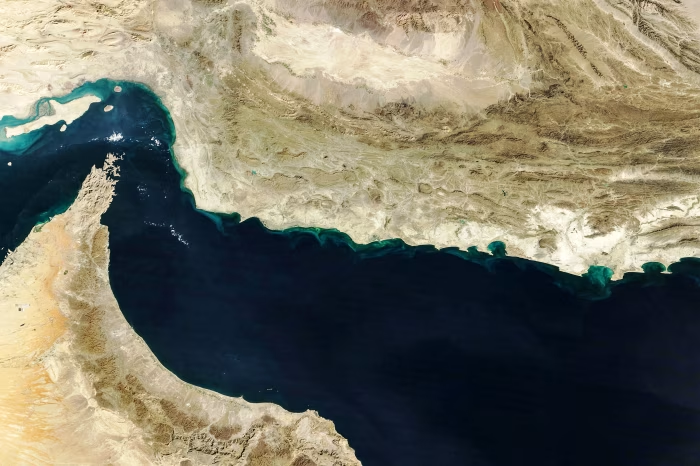
For months, Iran tried to squeeze the Strait of Hormuz oil route through missile attacks, naval interceptions, and repeated threats to shipping. Traffic slowed, but it never stopped. A reported minefield changes the equation.
Unlike missiles, sea mines don’t target a specific vessel. They remain in the water, threatening every tanker that passes regardless of its flag or destination. This matters because shipping companies can choose whether to sail, but they cannot do so without war-risk insurance.
Iran’s Revolutionary Guard Corps (IRGC) claimed this week that two tankers attempting to transit Hormuz struck mines and were destroyed. They warned that the route would remain unsafe for oil, gas, and petrochemical cargoes while US military operations continue. This caused a major spike in oil and gas prices.

Brent crude climbed above $90 per barrel, its highest level since June, while WTI also extended last week’s rally. The bigger warning sign came from shipping data. According to LSEG, only four vessels transited the Strait of Hormuz on Sunday. This is down from eight the previous day, suggesting shipowners are already becoming more cautious.
Also Read: Bitmine ETH Holdings Reach 5.77 Million Tokens in Major Treasury Move
The insurance market may now become the real battleground. War-risk premiums typically surge after credible threats to commercial shipping. Even without a formal closure of Hormuz, higher insurance costs can make voyages commercially unattractive. This effectively reduces supply before a single barrel of oil is officially taken off the market.

The ripple effects stretch well beyond oil to gas prices as well. Global natural gas markets remain divided between the US Henry Hub, Europe’s TTF, and Asia’s JKM benchmark. When geopolitical issues increase the spread between those hubs, LNG cargoes are redirected to whichever market offers the highest return. This pushes regional gas prices higher even without a disruption to production. Europe’s TTF benchmark has already climbed nearly 29% in July. Meanwhile, Henry Hub remains below $3/MMBtu/.
For consumers, the next move could show up quickly at the pump. The national US average for gas was sitting just below the politically sensitive $4-per-gallon price mark before the latest escalation. Analysts have repeatedly noted that sustained moves in crude prices usually feed into prices at the pump within about a week.
This stands in stark contrast to President Donald Trump’s Truth Social post on the same morning claiming oil, gasoline, and other consumer costs were “dropping FAST.” The market is telling a different story.

With gas prices rising, insurers reassessing Hormuz voyages, and one-fifth of global oil trade flowing through an increasingly dangerous waterway, the next leg of this rally may depend less on military action than on whether they are still willing to insure the ships.
Also Read: Record Yen Shorts Hit 2008 Highs as Traders Bet Big Against Japan

Written by Sahana Kiran
Sahana Kiran has been covering financial markets since 2019, with a focus on cryptocurrencies, fintech, and the geopolitical events shaping them. She previously reported for AmbCrypto and Watcher Guru, and now writes for BlockNow.