







Markets
July 12, 2026
US Inflation Data Expected at 4.2% YoY as CPI Hits Tuesday

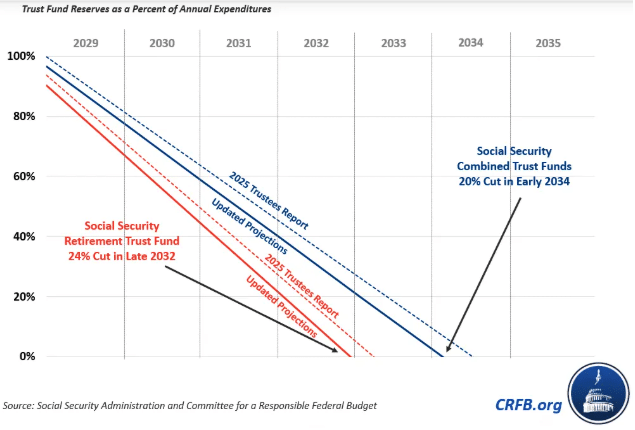
The debate around Social Security insolvency has intensified once again, with a Congressional Budget Office (CBO) report projecting that the Social Security trust fund, which supports retirement benefits, will be exhausted by 2032, a year earlier than it was previously anticipated.
According to the present laws surrounding it, Social Security can’t disburse more than what it has in revenues and interest. This means that once the trust runs out, we are looking at social security cuts of up to 28% for over 72 million people.
Also Read: Musk Sets X Money Launch While Vanguard Flags Americans Draining Retirement Funds

Explaining how the Social Security insolvency would force the government to cut benefits, the report reads,
“The government would continue to collect excise and payroll taxes designated for the funds, and the funds would continue to make payments. But because the government would not have the legal authority to make payments in excess of receipts, it would no longer be able to pay the full amounts scheduled or projected under current law.”
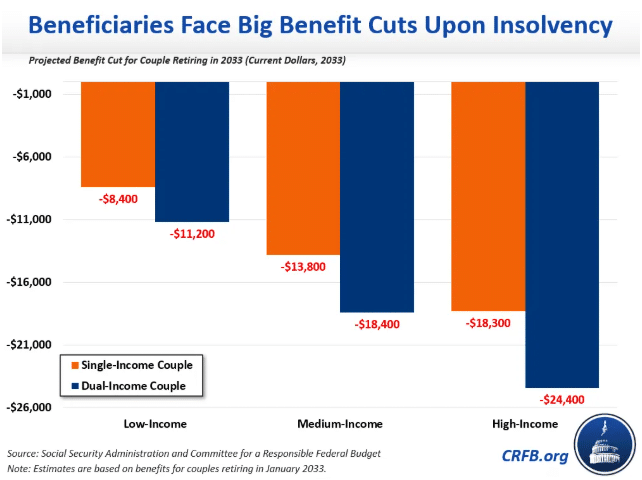
According to the Committee for a Responsible Federal Budget (CFRB), a low-income couple retiring in 2033 could lose up to $8,400 annually, while dual-income households at higher earnings levels could see cuts exceeding $24,000 per year.
The potential impact of the Social Security 2032 insolvency extends beyond benefit cuts. There’s also a growing fear that these benefit reductions could lower consumer spending and lead to a social security recession if the cuts happen abruptly.
The loss of purchasing power will affect local economies, especially in communities that have a large retiree population.
Also Read: Ripple Australia AFSL Deal Supercharges Regulated XRP Payments in APAC
Given the implications of Social Security insolvency, there is a growing demand for reforms to protect lower-income retirees. Solutions cited by experts include gradually limiting benefits for the high-earning groups or adjusting retirement ages.
For now, one thing is clear: the policymakers’ failure to act threatens the livelihoods of millions of retirees. Reforms are needed to prevent these Social Security cuts, or else we may be staring at reduced consumer spendings broader economic instability.

Written by Ali Alvi Kazim