


Markets
September 14, 2026
Fed, ECB and BOJ May Hike Together as $2.35T Carry Trade Faces Test

Key Takeaways
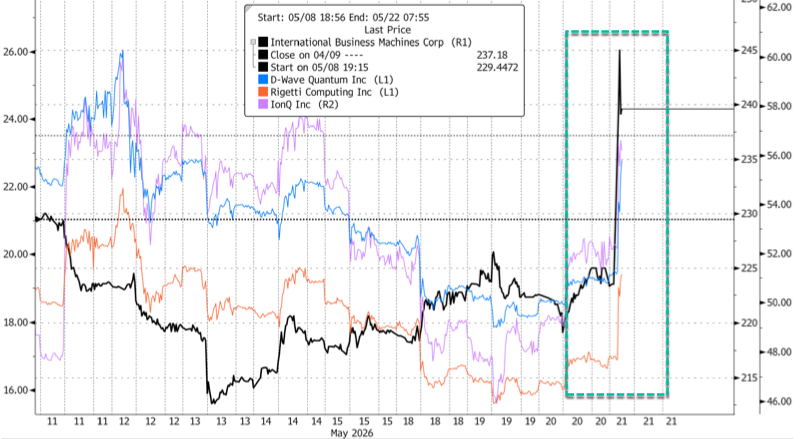
Quantum computing stocks got a boost after the Trump administration announced roughly $2 billion in CHIPS Act funding for nine US quantum firms. The funding comes with minority government equity stakes. This marks a notable push to build domestic quantum infrastructure. IBM stock discussions picked up after the company secured the largest share of the package in 2026, while D-Wave stock and Rigetti stock also moved sharply higher. The announcement adds another layer to the growing wave of quantum computing investment tied to national security and semiconductor policy.
Also Read: Kevin Warsh Fed Leadership: Crucial Decisions Await at June Meeting

IBM will receive $1 billion from the Commerce Department. It plans to match it with another $1 billion to help build a quantum chip foundry called Anderon in Albany, New York. According to reports, the government will take minority stakes in the companies receiving grants. GlobalFoundries secured $375 million. D-Wave, Rigetti, Infleqtion, Quantinuum, PsiQuantum, Atom Computing, and Diraq were also included in the program.
Officials said the funding is aimed at strengthening US quantum manufacturing and reducing dependence on foreign supply chains.

The market reacted quickly once the funding details became public. D-Wave stock rose around 19% during Thursday trading, while Rigetti stock gained roughly 15%. IBM shares climbed about 7%, and several smaller quantum firms also saw increased trading activity. Brandon Sun, managing director at Cohen Capital Markets, said,
“While quantum computing still carries meaningful technological and commercialization risks, government co-investment may give institutional investors greater confidence to evaluate these companies more seriously.”
Some investors compared the move to the administration’s earlier CHIPS Act deal with Intel in 2025. During this, the government also took an equity stake as part of its funding strategy. Analysts said government participation could help bring more institutional attention to the sector. This comes as many quantum companies remain years away from large-scale commercialization.
Also Read: Turkey Dumped 89% of Its US Bonds in March as Foreign Holdings Fell $139B
The funding package was spread across companies working on different types of quantum systems rather than backing one specific technology. This includes superconducting qubits, trapped ions, photonic computing, neutral atoms, quantum annealing, and silicon spin qubits.
Several from the community said the approach reflects how early the quantum industry still is. No clear winner has emerged yet, and most companies are still focused on scaling hardware, reducing error rates, and improving stability before commercial adoption becomes realistic.
Also Read: AI Crypto Tokens: The Full List Ranked by What They Actually Do

Written by Sahana Kiran
Sahana Kiran has been covering financial markets since 2019, with a focus on cryptocurrencies, fintech, and the geopolitical events shaping them. She previously reported for AmbCrypto and Watcher Guru, and now writes for BlockNow.