


Business
September 13, 2026
Revolut KYC Data Breach Leaks Names, Passport Photos, and Crypto Histories to Online Attackers

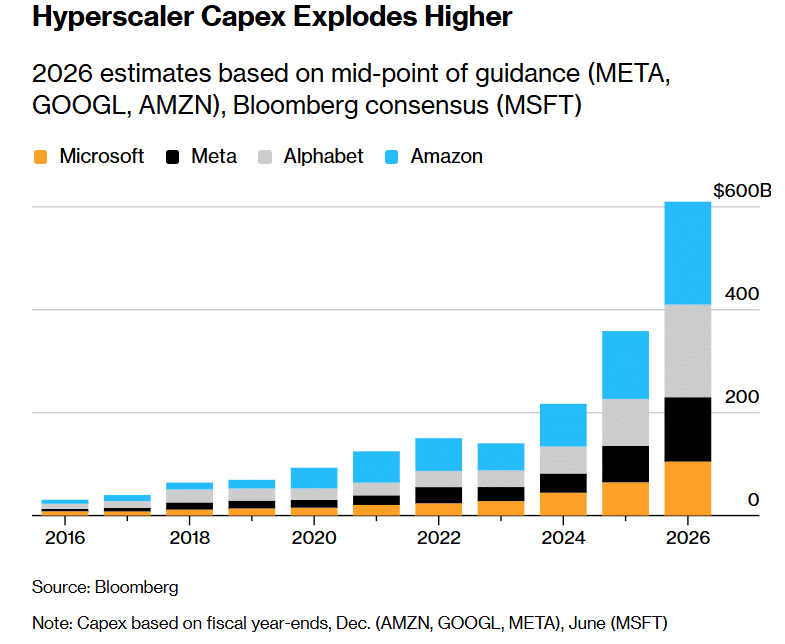
AI spending has reached unprecedented levels as Microsoft, Google, Amazon, and Meta prepare to deploy between $635 billion and $700 billion in capital expenditures for 2026. This represents a 67% to 74% surge from the $381 billion invested in 2025, marking the most aggressive push in technology history.
To finance this expansion, the four hyperscalers are expected to issue more than $400 billion in new debt this year, which is more than double the $165 billion raised in 2025. Roughly 90% of Big Tech’s operating cash flow is now being recycled into infrastructure, leaving minimal room for shareholder returns.
Also Read: Iran Proposes Hormuz Deal to US but Delays Nuclear Talks Until After War

The scale of capital deployment planned by these companies requires comparisons to historical infrastructure booms. Alphabet is targeting up to $185 billion in expenditures, Amazon plans to spend up to $200 billion, Meta has forecast between $115 billion and $135 billion, and Microsoft is projected to deploy approximately $145 billion on an annualized basis.

Alphabet has taken an unusual financing approach by offering a 100-year bond, making it the first tech company to sell a century bond since Motorola in 1997. The company’s initial $20 billion US dollar bond sale received over $100 billion in orders, demonstrating the market’s appetite for Big Tech debt despite massive AI spending requirements.
Gil Luria, an analyst at DA Davidson, explained the competitive pressure driving these investments:
“The four companies see the race to provide AI compute as the next winner-take-all or winner-takes-most market. And none of them is willing to lose.”
Google committed to invest up to $40 billion in Anthropic, with $10 billion now at a $350 billion valuation and another $30 billion tied to performance targets. Amazon also invested an additional $5 billion in Anthropic, part of a broader agreement for around 5 gigawatts of compute capacity. This AI spending surge reflects the companies’ belief that infrastructure dominance will determine market leadership.

Microsoft stock, Google stock, Amazon stock, and Meta stock have collectively lost over $950 billion in market value since announcing their earnings and outlooks. Amazon stock slid 8% following its capital expenditure announcement, while Microsoft stock triggered the second-biggest single-day decline in market value for any stock. Google stock and Meta stock also faced significant pressure from investors concerned about whether revenue can justify the investments.

Tomasz Tunguz, an investor at Theory Ventures who previously worked at Google, noted the fundamental shift:
“You’ve had these cash-generating machines. Now, all of a sudden they need that cash, and they need more of it, so they’re borrowing.”
Also Read: Oil Price: Goldman Raises Brent to $90 as Record Inventory Draws Accelerate
Morgan Stanley estimates that tech hyperscalers will borrow around $400 billion in 2026 alone. This surge will push total issuance of high-grade US corporate bonds to a record $2.25 trillion for the year. Last year, companies tapped debt markets for at least $200 billion, with projections climbing into the hundreds of billions for 2026.

The infrastructure buildout has created competition for finite resources such as electricians, cement trucks, and Nvidia chips. Luria acknowledged the execution challenges:
“There are and will be bottlenecks.”
Steve Lucas, CEO of Boomi, expressed skepticism about the economics and timeline for returns:
“I would not debate the potential of AI. I would absolutely debate the time frame, and I would passionately debate the economics.”
Earnings reports will provide the first real answer to whether AI spending at this scale can generate sufficient revenue. With the four largest hyperscalers deploying nearly four times what 21 major US industrial companies spend combined, investors are betting on whether infrastructure investments will deliver returns that justify the unprecedented capital deployment and debt accumulation driving this technological arms race.
Also Read: Chevron Q1 2026 Preview: Energy Sector Earnings in the Geopolitical Crosshairs

Written by Vladimir Popescu
Vladimir Popescu leads editorial coverage at BlockNow, with over 8 years in financial and tech journalism. He previously held editorial leadership roles at Watcher Guru and Windows Report, and has been cited by Forbes for his crypto market coverage.


