



Markets
September 14, 2026
Fed, ECB and BOJ May Hike Together as $2.35T Carry Trade Faces Test

Key Takeaways
The US national debt crisis intensified on Wednesday after total public debt surpassed forty trillion dollars in Washington. A sudden Treasury yield jump forced the federal government to intervene with massive liquidity support. A stark JPMorgan warning immediately questioned fiscal sustainability under current administration spending caps. Policymakers now face severe investor skepticism as escalating long-term borrowing costs threaten global financial stability.
Also Read: How High Can Bitcoin’s Price Go in the Rest of 2026?

The federal government executed a sudden capital injection to stabilize crashing sovereign bonds as the US national debt crisis reached critical limits. This unprecedented central maneuver followed a sharp Treasury yield jump that disrupted overnight lending markets.
Further, financial authorities launched an emergency bond buyback blitz to absorb illiquid government debt coupons. Analysts link this panic to an ongoing surge in domestic liabilities and dangerous leverage trends across global asset balances.

The aggressive capital injection failed to calm long-term lenders as persistent deficit spending fuels historic government bond volatility. Institutional investors are demanding higher yields to offset escalating sovereign default risks. This central market interference confirms that Washington cannot rely on normal debt auctions to fund escalating expenditures.
Also Read: HYPE Price Gains Ground as US Access Hopes Fuel the Biggest ETF Inflow Since July
Sovereign fixed-income markets faced heavy selling pressure after a premature federal liquidity injection backfired on Wednesday. This failed intervention triggered an immediate Treasury yield jump across longer-dated debt maturities. The 10y bond yield surpassed 4.73% on Friday 21st, surging to levels not seen in years.
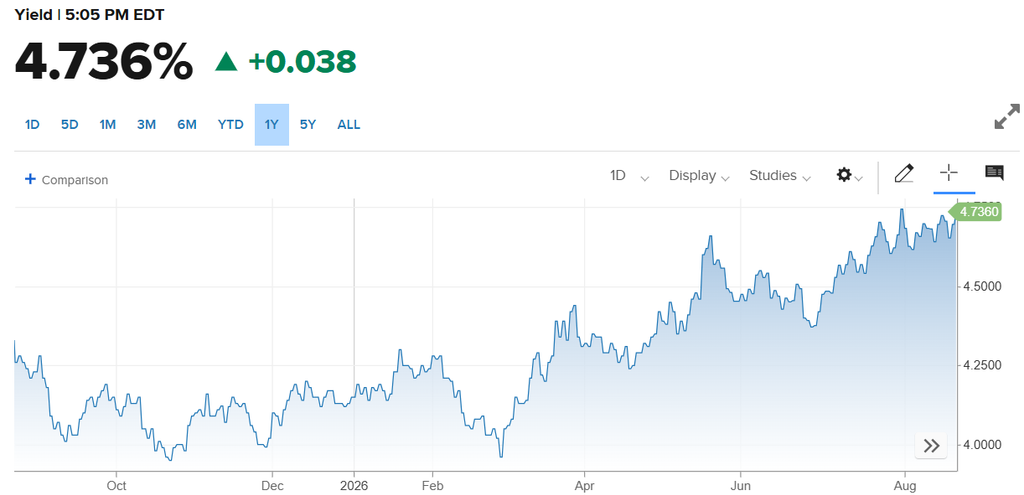
Bondholders aggressively unhedged their positions as the central intervention aggravated underlying government bond volatility. Indeed, 10Y bonds grew moved from 4% in March to over 4.73% now. Economists connected this marketplace anxiety to a grim economic assessment regarding the potential downfall of American financial hegemony and rising foreign currency competition.
This backdrop added immense weight to a sudden JPMorgan warning detailing structural fiscal vulnerabilities. Institutional funds began divesting from federal coupons because the hurried bond buyback blitz exposed deep ministerial desperation. Consequently, global lenders are asking for higher yields while Washington expands its total liabilities. This has a clear impact on the current US national debt crisis.
Traders completely erased the temporary relief from an initial four billion dollar central capital injection. This market skepticism deepened immediately. Treasury secretary Scott Bessent announced that upcoming long-term treasury bond purchase limits could actually scale much higher than four billion dollars per issue.
Also Read: Anthropic’s Valuation Nears Bitcoin as OpenAI’s Growth Loses Momentum

Written by Carlos Terenzi
Carlos Terenzi is a financial analyst with over 10 years of experience in crypto, finance, and international relations, focusing on Bitcoin, monetary policy, and precious metals.