







Markets
August 30, 2026
Panama Canal Congestion Deepens as El Niño Drought Sparks Energy Market Disruptions
The CLARITY Act still enjoys bipartisan backing, but that may no longer be enough to get it across the finish line this year. Galaxy Research has lowered its estimate of the bill becoming law in 2026 to 50%, arguing that the Senate’s shrinking legislative calendar is now the biggest obstacle. Lawmakers continue negotiating key provisions. Amidst this, opposition is also beginning to emerge from groups that say the bill could reshape parts of the traditional financial system.
Also Read: Morgan Stanley Says Cheap Housing May Never Return as US Household Debt Climbs

Galaxy Research has lowered the probability of the CLARITY Act becoming law in 2026 to 50%, down from 60% earlier this month. They are arguing that the Senate’s packed legislative schedule is narrowing the window for passage.
The research firm said the bill still has to clear the Senate with at least 60 votes before being reconciled with separate legislation from the Senate Agriculture Committee and the House-approved version. With appropriations, national security measures, and other priorities competing for floor time, Galaxy believes the timetable has become the biggest risk. Alex Thorn of Galaxy Digital said,
“In our view, Senate Majority Leader Thune needs to announce floor time by early July at the latest, possibly during the July 4 recess, with the vote itself occurring before the August recess. Absent a scheduling announcement on that timeline, the path slips to September, which runs directly into the midterm dynamics we have warned about, when controversial votes become very hard to schedule.“
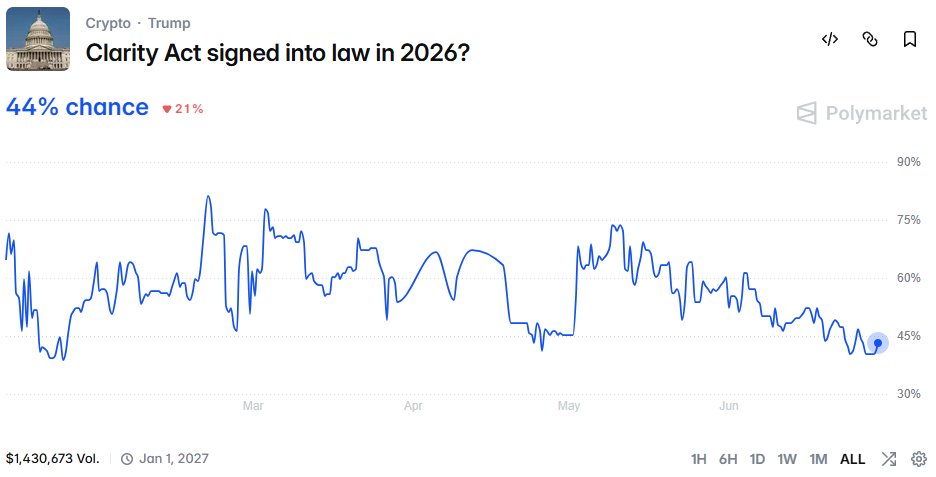
Prediction markets have also turned more cautious. On Polymarket, traders currently assign roughly a 44% chance of the CLARITY Act being signed into law this year. This shows the growing uncertainty despite continued industry backing.
The legislation is looked at as one of the most significant crypto bills in the US. This is because it would establish clearer boundaries between the Securities and Exchange Commission (SEC) and the Commodity Futures Trading Commission (CFTC), while setting registration standards for digital asset businesses.
Also Read: Corporate Profits Boom Hits New Heights in Q1 2026
The Senate timetable isn’t the only challenge facing the CLARITY Act. The Independent Community Bankers of America (ICBA), which represents nearly 4,000 community banks, has launched a six-figure advertising campaign opposing parts of the legislation. The group’s biggest concern centers on stablecoins. It argues that allowing issuers to offer rewards or incentives could encourage consumers to move deposits away from local banks and into crypto platforms.
According to the ICBA, that shift could pull as much as $1.3 trillion from community banks. This could potentially reduce lending capacity by roughly $850 billion for small businesses, farmers, and local communities. Community banks currently account for more than 60% of small-business loans and about 80% of agricultural lending in the US. The ICBA said,
“American families don’t want experiments with their money. They want jobs, growth, and available credit. When crypto gets a free pass, communities pay the price.”
The debate points to how the conversation around US crypto regulation has expanded beyond regulators and digital asset firms. While crypto companies view the CLARITY Act as a long-awaited framework for the industry, some traditional lenders see it as legislation that could alter the way deposits flow through the banking system.
Also Read: Precious Metals Drop as DXY Hits Multi-Year Highs

Written by Sahana Kiran
Sahana Kiran has been covering financial markets since 2019, with a focus on cryptocurrencies, fintech, and the geopolitical events shaping them. She previously reported for AmbCrypto and Watcher Guru, and now writes for BlockNow.