








Markets
August 23, 2026
Eurozone Flash PMI Growth Hits Nine-Month High, Hiring Turns Positive
Nearly half of the circulating XRP supply is currently held in exchange-linked wallets. This is even as banks begin testing their use in real payment systems. On one hand, there’s strong liquidity across trading platforms. On the other hand, institutions are exploring whether XRP-based infrastructure can support faster cross-border transfers. South Korea’s K Bank is part of that shift, but the gap between trading activity and real-world usage remains noticeable.
Also Read: Food Inflation Set to Accelerate as Farm Bankruptcies Surge 46% in 2025
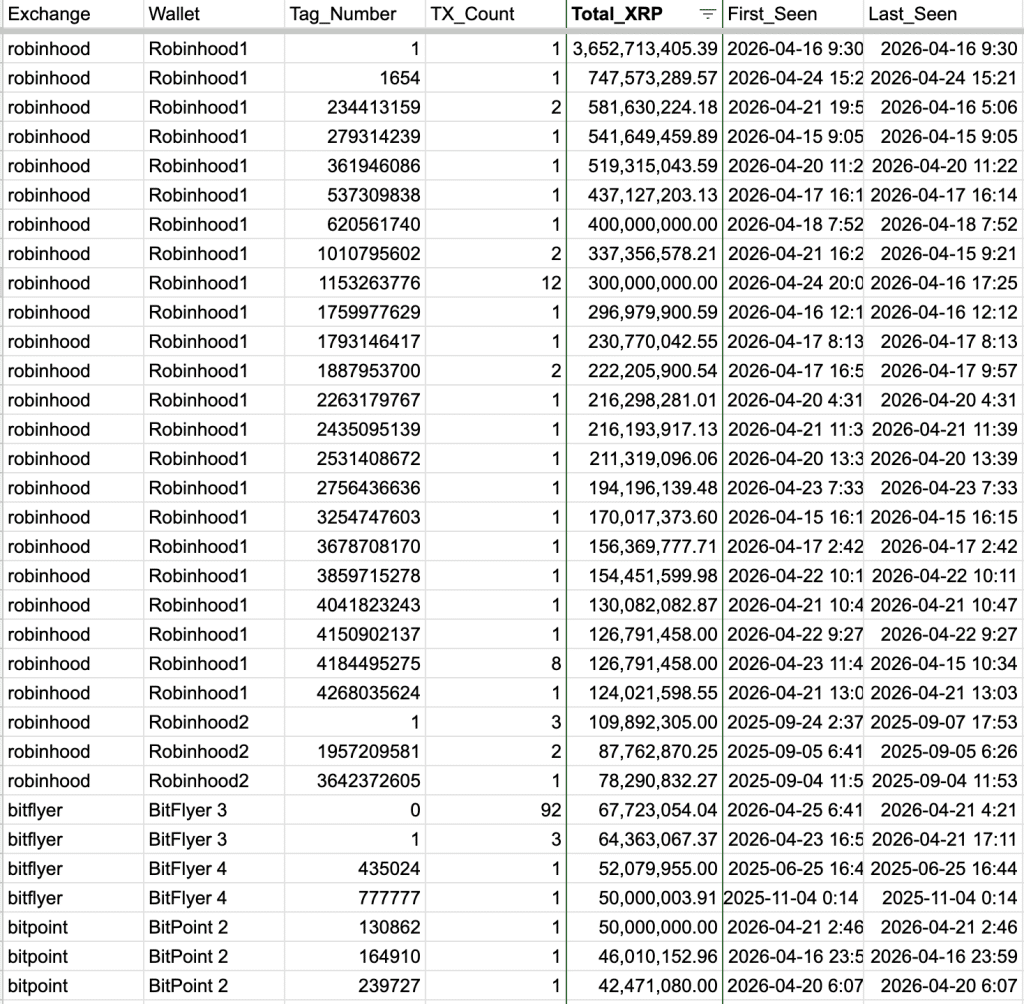
Recent data shows that around 13.26 billion XRP is sitting in tagged exchange accounts across more than 40 platforms and 260 wallets. Robinhood alone holds over 10 billion XRP, making it the largest contributor among tracked entities. Tagged holdings represent roughly 21% of the circulating supply. When additional exchange-linked wallets are included, that number rises to over 47%.
This level of concentration suggests XRP continues to function mostly as a highly liquid trading asset. Large balances on exchanges can support volume and accessibility. But they also point to limited movement into external use cases. The structure leans heavily toward trading activity rather than consistent utility-driven demand.
Also Read: The Petrodollar System: Why Oil Traders Can’t Escape the US Dollar

Amidst this, K Bank is working with Ripple on a proof-of-concept for cross-border payments. The bank, which is also the sole fiat partner for Upbit, has moved into a second phase of testing. This stage connects customer accounts directly with on-chain transactions. It includes corridors such as the UAE and Thailand.
The latest phase uses Ripple’s Palisade wallet to evaluate transaction stability, compliance, and scalability within a controlled environment. The focus remains on improving speed, reducing costs, and simplifying processes that typically involve multiple intermediaries. Ripple’s payments network, used by financial institutions globally, is designed to support these kinds of transfers.
At present, XRP remains heavily concentrated on exchanges, even as banks begin testing its role in cross-border payments. Whether these changes will depend on how quickly these trials move beyond controlled environments and into live systems.
Also Read: Microsoft, Google, Amazon, Meta Issuing $400B Debt as Capex Surges 74%

Written by Sahana Kiran
Sahana Kiran has been covering financial markets since 2019, with a focus on cryptocurrencies, fintech, and the geopolitical events shaping them. She previously reported for AmbCrypto and Watcher Guru, and now writes for BlockNow.